Proposal automation for agencies
Turn New Business Opportunities Into Client-Ready Proposals Fast
Proposal automation for agencies transforms scattered discovery notes, service inputs and pricing decisions into a controlled proposal workflow. Produce stronger proposals, respond faster and protect senior-team capacity without sacrificing strategic judgement.
The proposal bottleneck
Winning Work Should Not Depend on Rebuilding Every Proposal From Scratch
Opportunities lose momentum when proposal production is slow, inconsistent or dependent on one senior person. The result is wasted capacity, delayed follow-up and weaker new-business execution.
Slow Turnaround
Strong opportunities cool while teams gather notes, chase inputs and assemble another proposal manually.
Senior-Team Dependence
Directors repeatedly rewrite positioning, scope and recommendations instead of concentrating on the decision that wins the work.
Inconsistent Quality
Proposal structure, commercial language and service detail change depending on who produces the document.
Commercial Risk
Uncontrolled versions, outdated pricing and vague scope create confusion before delivery has even started.
THE PROPOSAL SYSTEM
What Proposal Automation Can Handle
Every system is built around the way your agency qualifies opportunities, recommends services, approves pricing and presents its value.
Discovery Capture
Turn call notes, forms and opportunity data into structured proposal inputs.
- Client objectives and priorities
- Current challenges and constraints
- Budget and timescale inputs
- Stakeholder and decision data
Opportunity Qualification
Apply clear criteria before expensive proposal-production work begins.
- Fit and readiness checks
- Required-information controls
- Commercial opportunity scoring
- Approval to proceed
Solution Assembly
Build a relevant recommendation from approved services, deliverables and logic.
- Service selection rules
- Deliverable mapping
- Recommended implementation stages
- Relevant proof and case studies
Scope and Pricing
Structure the commercial offer using controlled packages and pricing inputs.
- Defined scope boundaries
- Pricing and package controls
- Optional service modules
- Commercial assumption checks
Document Production
Assemble approved content into a consistent, client-ready proposal.
- Agency-branded structure
- Client-specific content
- Controlled terminology
- Consistent formatting
Review and Follow-Up
Move every proposal through clear approval, delivery and follow-up stages.
- Internal review routing
- Revision and approval records
- Delivery confirmation
- Follow-up task creation
THE proposal workflow
From Discovery Call to Approved Proposal
Proposal automation controls the production process while your team retains authority over strategy, pricing and the final recommendation.
Capture
Structure the client’s objectives, requirements and commercial context.
Qualify
Confirm fit, readiness and the information required to proceed.
Assemble
Build the recommended scope from approved services and proposal content.
Approve
Route pricing, strategy and commercial terms to the correct decision-makers.
Deliver
Issue the approved proposal and trigger a structured follow-up process.
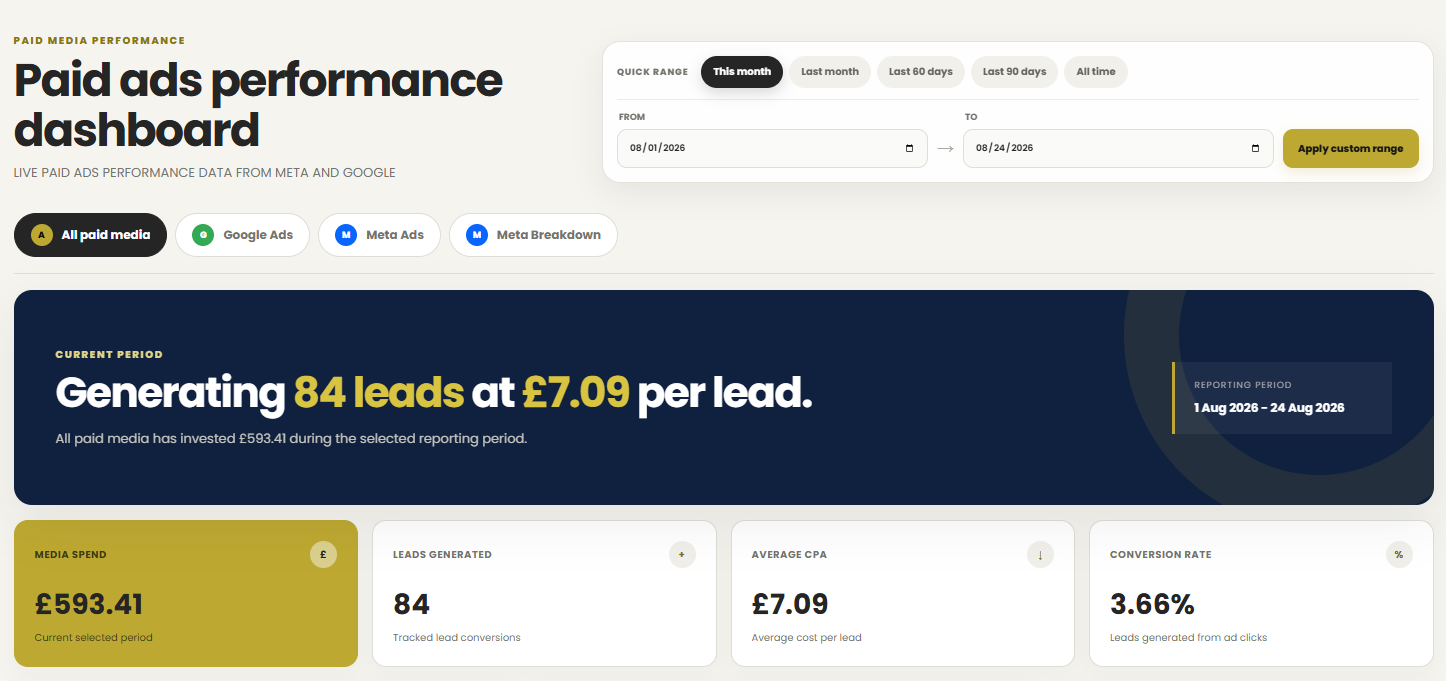
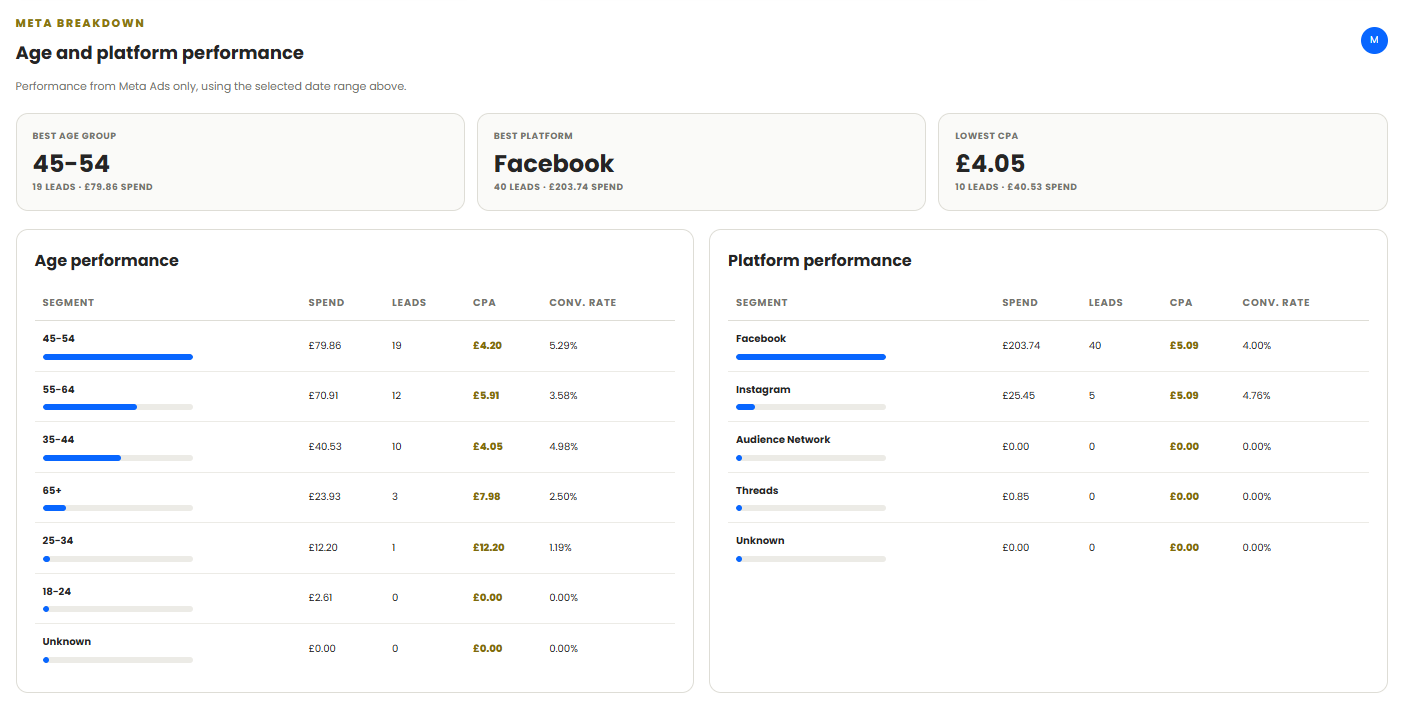
Example of a custom reporting dashboard built by Performance AI Systems
A REAL REPORTING OUTPUT
Custom Reporting Systems Built for Agencies and Their Clients
Every dashboard or reporting portal is designed around the agency’s reporting process and customised to reflect each client’s platforms, objectives, KPIs and commercial priorities. The agency gains a more efficient and consistent reporting system, while its clients receive a clearer, more relevant view of performance.
OPERATIONAL OUTCOMES
Turn Reporting Into a Scalable Agency Advantage
Better reporting systems reduce operational workload, strengthen client communication and allow your agency to serve more accounts without reporting becoming a barrier to growth.
Less Production Work
Reduce repeated exporting, copying, formatting and administration.
More Time for Insight
Allow specialists to concentrate on meaning, action and strategy.
Greater Consistency
Apply common reporting standards across clients and account managers.
Cleaner Agency Growth
Increase reporting capacity before immediately adding headcount.
EXISTING REPORTING STACK
Built Around the Tools Your Agency Already Uses
Get more from the reporting stack you already have. We connect your existing platforms, dashboards and workflows into a faster, more consistent reporting system—adding automation where it creates the greatest value.
Advertising Platforms
Google Ads, Meta Ads and other paid-media data sources.
Analytics and Tracking
GA4, conversion data and relevant measurement platforms.
Reporting Tools
Dashboards, spreadsheets and existing report templates.
Workflow Platforms
Project tools, communication channels and approval workflows.
IMPLEMENTATION
From Reporting Bottleneck to Working System
Every agency reporting automation project begins by mapping your existing reports, data sources, responsibilities and approval process.
Audit
Review reports, data sources, production steps and delivery stages.
Map
Define metrics, ownership, validation and approval requirements.
Build
Create and test the reporting workflow using real account data.
Handover
Provide documentation, training, controls and clear ownership.
FREQUENTLY ASKED QUESTIONS
Questions Agencies Ask About Reporting Automation
The free audit identifies whether your current reporting process is ready for automation and where the greatest opportunity sits.
What is agency reporting automation?
It is a structured workflow that automates repetitive reporting tasks such as data collection, validation, dashboard updates, draft commentary, approvals and distribution.
Will reporting automation replace account managers?
No. It removes repetitive reporting production work while keeping interpretation, strategic context and client-facing accountability with your account managers.
Can it work with our existing dashboards?
Yes, in many cases. We can connect and enhance your existing dashboards, spreadsheets, data sources and report templates, adding automation where it creates the most value without forcing an unnecessary rebuild.
Can AI write client report commentary?
AI can prepare structured draft commentary using approved data, reporting rules and performance context. The account manager retains responsibility for adding client-specific insight and approving the final commentary before delivery.
How do you protect reporting accuracy?
Each system uses defined data sources, reporting-period controls, validation rules and exception flags. Reports can then pass through a documented human-review and approval process before reaching the client.
How long does implementation take?
The timescale depends on the number of platforms, reports, clients and approval stages involved. A focused reporting system can often be designed, tested and implemented within a few weeks.
See How Much Agency Time Your Reporting Process Is Consuming
Book a free 30-minute automation audit. Discover where agency reporting automation could save time, improve consistency and increase capacity across your client accounts.
Book a Free Automation AuditNo commitment. 30-minute call. Built for performance-driven agencies.